Learning is....
Planting a seed in our brain... learning to water, nurture and grow it.... so we can live on the fruit of our learning and plant more seeds.

Showing posts with label maps. Show all posts

Wednesday, 2 April 2014

Anzac Day Reading Unit - The Donkey Man

Every year I do an Anzac Day unit.  I consider that Anzac Day is one of two very important days in the history of New Zealand (the other being Waitangi Day) that forged this country.  Because I do this unit every year I need to keep it fresh for me and for the students I've had the year before.  In 2013 it wasn't really an issue as I was at a new school, but in the past I've focused exclusively on Gallipoli one year, the Western Front in France and Belgium the next, the home front another year, and then on World War II the next year.

In 2013 I decided for one reading group we would focus on this excellent picture book, The Donkey Man by Glyn Harper.

 
Glyn Harper is a history professor at Massey University, who specialises in war history.  He has written heaps of books about various wars and topics within, for both adults and children.  I really like this book because it is written from the point of view of a donkey at Gallipoli.  Children can relate to that concept to understand the place Gallipoli was.


My first session with the group was to use the front cover as a launch pad for some predicting.  I wanted my group to form a hypothesis each just using the cover.  First we talked about what a hypothesis is.  I supplied them with a black and white photocopy to make their hypotheses, which brought about some interesting responses.

 
The hypotheses the group came up with did not mention war.  In fact they thought it was going to be about a donkey on a farm!!  So then I had to show them the actual book cover.  When they saw the red cross on the bandage on the donkey's nose they had a better understanding.
 
So I gave them another go at the hypothesis (see the picture below) once they saw it in colour.  Then we talked about what a blurb on the back cover was. 
 
 
After discussing the blurb we then revisited our hypotheses to decide if they still stood up and then investigated where Gallipoli is.
 
 
I like to use maps, pictures, graphic organisers and other visual aids to give the children context as they read.  The above maps that I used were a world map (giving context to where New Zealand is in comparison to Gallipoli); a map that focuses on the general area around Turkey (give context to neighbouring countries, especially on the fact that Britain wanted access to the Black Sea so Russia had a warm water port close to Europe); a map of Turkey (to see how big Turkey is in comparison to the area being fought over); and finally the map of the Gallipoli Peninsula to see where the attacks actually happened.
  

As you can see from the above picture, I used De Bono's thinking hats to get the group thinking about how the cover of the book impacts your impression.  We learnt from starting with a black and white cover to going to a colour cover how your impression of the book changes.  So by using De Bono's yellow/benefits thinking hat we discussed how having the coloured cover was able to help with making a hypothesis more so than the black and white cover; the colour gives so much more detail.  Using the blurb also impacts on what you think about the story.
 
So before we have even started reading the text, there is a lot of discussion and prediction about the book.  We have used a lot of visual aides too, to enable an understanding of where the events in this book are taking place and why.
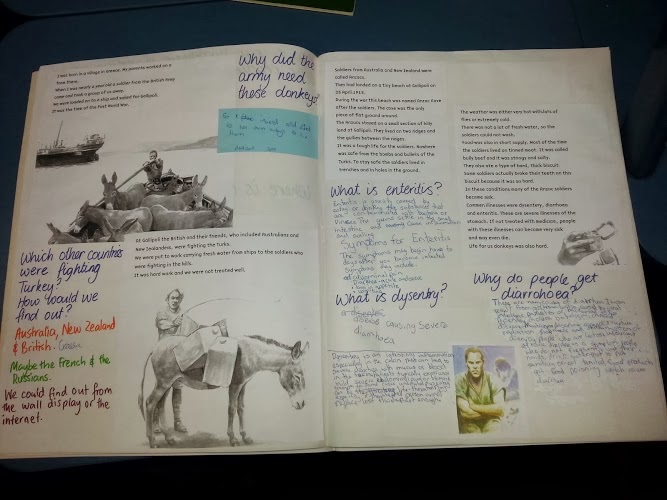
 

I did photo copy the book and glue the story into the group's modelling book.  I did this so we would be able to highlight aspects of text and to focus only on the pages that we were currently working on.  I really did not want my original text drawn all over!!  This also allowed me to ask questions pertaining to that particular piece of text. 
 
As you can see above, this first lot of text talked about some of the more serious adverse conditions the soldiers faced at Gallipoli apart from bullets - disease.  So I sent the kids off with the dictionary, i-pads and/or computers to do some research into what dysentery and enteritis is, and how someone gets diarrhoea.  This was a fairly hefty bit of research. 
 
You cansee that I use the modelling books to record the children's thoughts in a variety of ways.  Sometimes I have done some writing; sometimes they have done some writing independently on bits of paper and glued them in; and they also do some collaborative writing directly into the book.
 
 
I really wanted the group to understand what life was like in the trenches.  And luckily there was a news article on the Stuff website of recent research into the diet of the soldiers at Gallipoli, which Glyn Harper, the author of The Donkey Man, was party to.  So I interrupted our reading of The Donkey Man to read the article Diet did Anzacs no favours.  This brought in a lot of new language that we had to investigate as we read.  I then sent them off to find the key parts of the Gallipoli soldier's rations in picture form from the internet.  They had to print these out and glue them in the modelling book and label them.
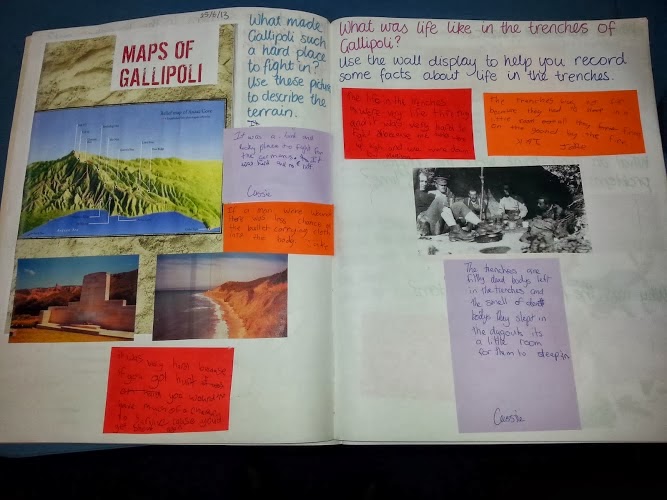


We then looked at other aspects that made Gallipoli challenging to the soldiers, such as the landscape, dead bodies that couldn't be removed, where they slept, flies, lice, fleas, weather.....  I used maps from other books, such as Gallipoli Reckless Valour by Nicolas Brasch, and photos from my own trip to Gallipoli for the Anzac Day commemoration in 2001.  I had set up the wall display (see below) to also help.  It had further photos from my trip to Gallipoli as well as pictures and text from selected books on trench life.
 
 
You can also see that my display also has references to the battlefields of France and Belguim.  I've also included a photo of my great grandfather who fought at Passchendaele and statistics from World War 1 which I felt were relevant.
 
Then it was time for a bit of a recap of what we knew before delving into the role of the donkeys at Gallipoli.
 
 
This next piece of text enabled us to consider some things that were explicitly said in the text and some things that we had to make educated assumptions about.  A good way of bringing those inferential skills into the lesson.
 
 
Some prediction skills came into this part of the text.  This is the good reason for photocopying the book.  You can control how far into the text the students get, to prevent them from wrecking all those wonderful skills like prediction and making hypotheses that you want to teach them.


On this page I was focusing on two main things:
  • using bullet points to list facts.
  • using inference to come to a conclusion about something that is not fully explained in the text.
The inference also meant they had to use what they had learnt from other sources such as photographs, videos we had watched, other text sources as well as this book.
 
 
Here I introduced the story of Simpson Kirkpatrick, from the book Gallipoli: Reckless Valour and we also had the poster on the wall display.  The students went away and found out some additional information at Simpson and created their own fact file about this legendary person from Gallipoli.
 
 
On this page there was a fair bit of inference in answering the questions and also using knowledge gleaned from other sources (other texts, videos, pictures).  The children are having to draw conclusions of their own, because this text is not explicitly telling the reader why these things are happening.
 
 
Finally the book has a factual bio about Richard Henderson to tell us what happened to him after Gallipoli.  I also told the group about who the author was, what he also did apart from writing this book.  I asked them to write questions for Glyn Harper.
 
I wanted to email the questions to Glyn, but we just ran out of time due to interruptions.  Another group I was working with did send him questions in relation to the Stuff article about the rations, and he was able to help us out with some answers.  It is really valuable for the students to be able to communicate with the authors.
 
We also verbally went back to our initial hypotheses about the book and discussed how accurate or different they were from the book now we had read it.
 
This was a great book to read with an able group of readers.  I would have preferred we hadn't had so many interruptions so we got through the book quicker, but we did take the opportunity to bring in other sources to give context to the time and place and events that we were reading about and this enhanced the learning for the students.

Sunday, 18 August 2013

Newsboard... or Current Events

Many moons ago I went to a literacy course run by Jill Eggleton.  One of the many things she showed us to improve literacy in our class was the Newsboard, aka, Current Events. 

And this is not the old fashioned getting the kids to bring in a newspaper cutting - although that does have it's place. 

No, this Newsboard not only endeavours to widen children's minds of what is happening in the world, but to develop thinking, visual and oral language skills, as well as cover many specific teaching points of writing and reading literacy.  I also find that the Newsboard gets the children initiating conversations at home on the topics we cover and taking greater interest in the 6 o'clock news or the newspapers that come into their homes.  Ever since I have always used this in my class.

I use this for the following reasons to improve literacy:


Current Events awareness it is important for the children to become aware that there is more to the world than their family and their school.  Through Current Events they can learn about important people in their community, country and the world.  In the example illustrated to the right, I took this opportunity to discuss the passing of one of New Zealand's fore most artist and the kind of art he was involved in.  I normally only reserve colour pictures for really important events, but you can not look at art in black and white... hence the colour.

 
It is a great way to introduce the children to new vocabulary.  You are teaching them to read new words and the meanings of them.  It is also a great way to reinforce dictionary skills.  Really important stuff like using guide words, identifying which definition (if there is more than one) applies to the sentence, root words, prefixes, suffixes.....


As you can see here I have looked at prefixes (pink) and the differences between English English and American English, as well as the meanings of some new vocabulary.
  
 
 My focus on this page was looking at why we can use capital letters - in this case for the names of Awards, authors/names and book titles.  We were also reading as a read-to book My Brother's War so it was quite timely that these awards came out.  By the way I do recommend My Brother's War.  It is set during WWI and tells the story of two brothers, one who volunteered and one who was a conscientious objector, and their expriences of WWI.  I read it to my class of 8-13 year old children (Years 4-8).  One of the great things about this book is how it uses letters and switches between the two brothers stories.  One of the girls in my class even asked her mum to buy her the book so she could read it for herself and another is now reading my copy in her down time.
 
 
In the above example, not only have I looked at new vocabulary, but I have also looked at how brackets can be used to give more information.
 
 
The Newsbook is a great way to model using thinking tools.  Above you can see how I have used Tony Ryan's Thinkers Keys, in particular the "What if?" key to get the children thinking about what they would save first if their home caught on fire, due to government Minister Paula Bennett saving her cabinet papers when her house caught on fire.
 
 
In this example you can see I am using De Bono's Thinking Hats and Gardner's Multiple Intelligences to generate the childrens' thinking.  In this case we looked at the benefits (yellow hat) of having running water in public loos and explored all the names we could think of for a toilet.
 
 
In this example I've used De Bono's Thinking Hats again.  I choose this topic for the day as we allow scooters and skateboards at our school, but don't enforce the use of helmets or other protective gear.  We used our judgement (black) hat to say whether or not we should used helmets and protective gear at school and then the children justified the benefits (yellow hat) of having said gear at school or not.  Afterwards we rang my mother who is the Trauma Nurse Co-ordinator at Waikato Hospital to find out what sort of injuries we could get from scooter crashes.  You will note that we all looked at how we use letters to shorten the names of things, i.e. ACC for Accident Compensation Corporation.  By the way, the kids did not come around to my way of thinking for wearing protective gear at school.
 
 
As you can see in this example I introduced the idea of Blooms Taxonomy into our thinking about the very contentious topic of Ask.FM.  Ask.FM has been in the media a lot over the last few months due to worries by young people, parents, educators and internet guardians over the way this social media can be used to bully.  My class (hopefully) are too young to be interested in this social media, but I wanted to introduce it to them like this to reinforce some notions on cyber safety and to hopefully get them to start a conversation at home.  In the example above you can see I have used the skills analyse, evaluate and understand from Blooms Taxonomy to get the children thinking about the implications of bullying and social media together.
 
 
Where in the world are we?  Where is that place they're talking about - is it in the South Island?  Why do American's think New Zealand is part of Australia and that kangaroos live here?  One of the visual literacy skills I think is really important for children to learn is how to read a map.  I personally love maps, and I think that was instilled in me by the teacher I had from Standard 2-4 (years 4-6).  The example above was from when our Prime Minister John Key went to visit the leaders of several Central and South American countries.  I wanted my class to see and understand where those places were.  There are a few simple map reading skills I think are important:
  • find New Zealand on a world map.
  • find key places in New Zealand on a New Zealand map, e.g. important cities (Auckland, Hamilton, Wellington, Christchurch, Dunedin...), identify the main islands (North, South and Stewart), identify major water ways (Pacific Ocean, Tasman Sea, Cooks Strait, Waikato River, Lake Taupo...), find our significant mountains (Mt Ruapehu, Mt Cook...).
  • know where the place they come from is.
  • be able to know where some key countries in the world are that are important to New Zealand, e.g. Australia, USA, Canada, Japan, China, UK, France, South Africa and Argentina (after all the All Blacks play those last three countries fairly regularly).
  • know how to identify the capital city of a country.
 
Consequently maps of New Zealand, the world and specific parts of the world will feature to help give my students context of the event that has happened.  This example above was quite fun, figuring out how a Chihuahua got from Avondale to Whangarei on her own (De Bono's red hat - using our intuitions) combined with identifying where Auckland and Whangarei are (map reading).
 
 
And another combination of map reading skills and De Bono's black thinking hat to make judgements on how a life threatening situation was handled so poorly by a health worker.
 
 
One very fun part of visual literacy is cartoons.  I love bringing cartoons into the situations and discussing the humour behind them, how the cartoonist has enhanced specific physical features of individuals involved to give them character, how different objects in the cartoon can be used to illustrate or symbolise other ideas, and how pictures can symbolise some classic language features - such as the foot in mouth in the top cartoon above and the scraping the bottom of the barrel in the bottom cartoon.


And one of the greatest mysteries to us in the weather.  In New Zealand we are obsessed with the weather.  When's it going to rain?  When will this rain stop?  Why is it so cold?  Why is it so windy?  So being able to understand weather symbols and the weather maps are another important visual literacy skill.