Learning is....
Planting a seed in our brain... learning to water, nurture and grow it.... so we can live on the fruit of our learning and plant more seeds.

Showing posts with label De Bono's Thinking Hats. Show all posts

Wednesday, 28 May 2014

Creating excitement about learning for Anzac Day

The other week I put up a new display about Anzac Day. It's a pretty tame one considering all the possible things I could put up. But the main idea is to get the kids thinking and it gives them some independent activities to do.
 
 
The following Monday a couple of really cool buzz things happened for me.  One girl had been looking through the local newspapers at the weekend, and when she arrived at school she came over and said, "Look what I found out about Anzac Day in the newspapers!"
 
I loved the fact that she had cut these  articles out of the local papers off her own bat and brought them into school. So I immediately gave her the pins and asked her to add them to the display.


Later the same day, another girl came to me after silent reading. She had one of the books from my Anzac collection she had been reading during SSR.  "Look Miss D.  That's from the poem we had last week."
 

She found it in Jackie French's book A Day to Remember - The Story of Anzac Day.


Each week we have a poem of the week and in the first week of this term we did For the Fallen by Robert Laurence Binyon.
 

This is a pretty full on poem to give to students aged 7, but my current class caters for Years 3-8 in a small two class rural school.  Not only do I have to cater for the younger children in my class, but I need to challenge the more able and older children as well.  So each week there is a different sort of poem, often with a theme I want to explore.

With this poem we looked at the imagery in the poem, new vocabulary, the variety of punctuation, and blends - a new aspect each day.  We also found out a little bit about who Robert Lawrence Binyon was.
 
Since then, other children have also read this book and recognised the extract from Binyon's poem as well.  It is all about planting that seed and seeing what takes root.
 
So what else have I got going on in this display?
 

This is a great poster I got from the Scholastic Book Club a few years ago (why don't they come like they used to anymore?).  This is a great poster to get the kids thinking about the symbols and rituals of Anzac Day.


I got these words that are in the Vocabulary Expander out of the book Gallipoli Reckless Valour a few years ago.  The point of the Vocabulary Expander is to introduce and extend the vocabulary of the topic to the students and help them create meaning of these words.  The students each choose a word and bags it by writing their name on the back with a dry erase pen.  It the top box they write the word as a title.  On the next lines they record the definition that best fits the context.  They must start with a dictionary first, then if they can not find it, they can Google the definition.  The next set of lines is when they write a sentence of their own using the word.  In the bottom box they draw a picture to illustrate the sentence they wrote, demonstrating the context of the word as well.  This is an independent reading time activity and can also be worked on during topic time.

This set of statistics is a good way to get the students thinking about and discussing the impact of the First World War on a small, young country like New Zealand.

It gets them thinking about women and how they contributed to the war effort.  It makes them think about the contribution of Maori and the people of the Pacific to the New Zealand Armed Forces.  It brings to their attention the fact that there was something called a conscientious objector.

These statistics also brings death and the stark reality of war into focus when you look at how many soldiers did not come back out of the103,000 who served overseas, as well as the ones who came back wounded in some way or another.

And is it not amazing to know that there are approximately 500 civic memorials in New Zealand commemorating these men?

These are for the older students in my class.  I created these a couple of years ago for independent inquiry on a range of aspects of New Zealand's participation in war.  The students choose which one they will do.  Each one has web links and different activities to complete based on De Bono's Thinking Hats or Gardner's Multiple Intelligences. 

The topics I have put out for the small group of students to do this year include:
  • Conscientious Objectors
  • Le Quesnoy and New Zealand
  • Helping the Wounded
  • WWI Memorials
  • Medals
  • Mascots for WW1 & WWII
The tasks may require them to create something on the computer, do a poster, or record the facts in their books. 

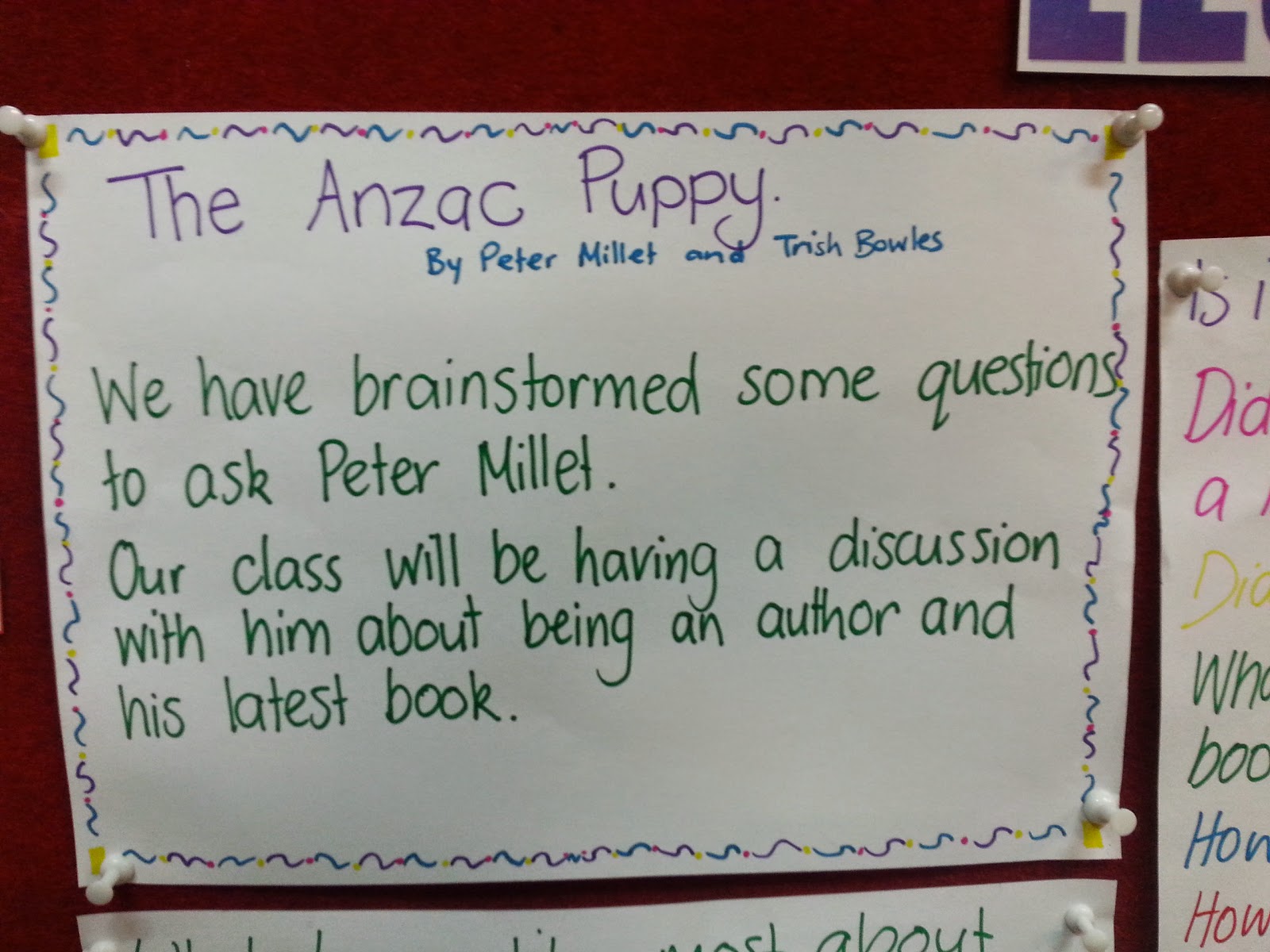
One of the first books I read my class this term was The Anzac Puppy  by Peter Millett and illustrated by Trish Bowles.  I blogged about this book during the term break after I bought a fresh collection of stories to share with the class.  Peter Millett somehow really quickly saw my blog and responded to it, saying he'd love to discuss the book with the class.  My class brainstormed questions for Peter (see below) and we're set up to do a Skype session with Peter this week.


In my opinion I can not set up an Anzac Day display without the immortal words of Ataturk, the Turkish commander at Gallipoli and later leader of Turkey:


And it is also good to get some other background on some important Gallipoli knowledge and Anzac traditions:


Finally, I was away the other day and the reliever read the class Ceasar the Anzac Dog by Patricia Stroud and illustrated by Bruce Potter.


 And he drew this for the kids on the board, so I photographed it, printed it and added it to the display:


I love how everyone who enters my class brings yet another little bit extra to what we are learning and carries on the inspiration.

Wednesday, 2 April 2014

Anzac Day Reading Unit - The Donkey Man

Every year I do an Anzac Day unit.  I consider that Anzac Day is one of two very important days in the history of New Zealand (the other being Waitangi Day) that forged this country.  Because I do this unit every year I need to keep it fresh for me and for the students I've had the year before.  In 2013 it wasn't really an issue as I was at a new school, but in the past I've focused exclusively on Gallipoli one year, the Western Front in France and Belgium the next, the home front another year, and then on World War II the next year.

In 2013 I decided for one reading group we would focus on this excellent picture book, The Donkey Man by Glyn Harper.

 
Glyn Harper is a history professor at Massey University, who specialises in war history.  He has written heaps of books about various wars and topics within, for both adults and children.  I really like this book because it is written from the point of view of a donkey at Gallipoli.  Children can relate to that concept to understand the place Gallipoli was.


My first session with the group was to use the front cover as a launch pad for some predicting.  I wanted my group to form a hypothesis each just using the cover.  First we talked about what a hypothesis is.  I supplied them with a black and white photocopy to make their hypotheses, which brought about some interesting responses.

 
The hypotheses the group came up with did not mention war.  In fact they thought it was going to be about a donkey on a farm!!  So then I had to show them the actual book cover.  When they saw the red cross on the bandage on the donkey's nose they had a better understanding.
 
So I gave them another go at the hypothesis (see the picture below) once they saw it in colour.  Then we talked about what a blurb on the back cover was. 
 
 
After discussing the blurb we then revisited our hypotheses to decide if they still stood up and then investigated where Gallipoli is.
 
 
I like to use maps, pictures, graphic organisers and other visual aids to give the children context as they read.  The above maps that I used were a world map (giving context to where New Zealand is in comparison to Gallipoli); a map that focuses on the general area around Turkey (give context to neighbouring countries, especially on the fact that Britain wanted access to the Black Sea so Russia had a warm water port close to Europe); a map of Turkey (to see how big Turkey is in comparison to the area being fought over); and finally the map of the Gallipoli Peninsula to see where the attacks actually happened.
  

As you can see from the above picture, I used De Bono's thinking hats to get the group thinking about how the cover of the book impacts your impression.  We learnt from starting with a black and white cover to going to a colour cover how your impression of the book changes.  So by using De Bono's yellow/benefits thinking hat we discussed how having the coloured cover was able to help with making a hypothesis more so than the black and white cover; the colour gives so much more detail.  Using the blurb also impacts on what you think about the story.
 
So before we have even started reading the text, there is a lot of discussion and prediction about the book.  We have used a lot of visual aides too, to enable an understanding of where the events in this book are taking place and why.
 

I did photo copy the book and glue the story into the group's modelling book.  I did this so we would be able to highlight aspects of text and to focus only on the pages that we were currently working on.  I really did not want my original text drawn all over!!  This also allowed me to ask questions pertaining to that particular piece of text. 
 
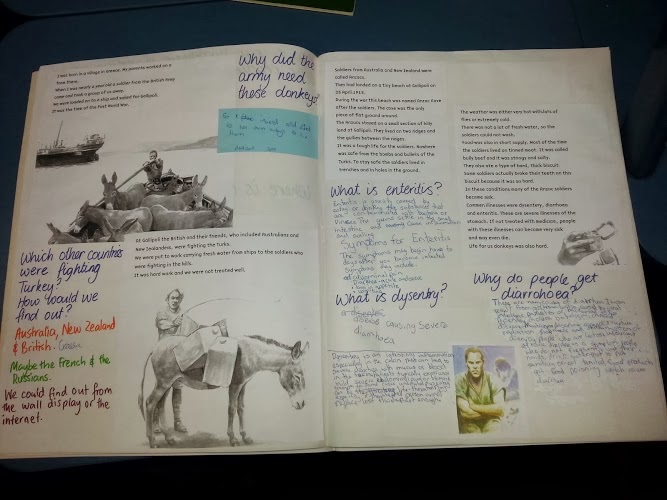
As you can see above, this first lot of text talked about some of the more serious adverse conditions the soldiers faced at Gallipoli apart from bullets - disease.  So I sent the kids off with the dictionary, i-pads and/or computers to do some research into what dysentery and enteritis is, and how someone gets diarrhoea.  This was a fairly hefty bit of research. 
 
You cansee that I use the modelling books to record the children's thoughts in a variety of ways.  Sometimes I have done some writing; sometimes they have done some writing independently on bits of paper and glued them in; and they also do some collaborative writing directly into the book.
 
 
I really wanted the group to understand what life was like in the trenches.  And luckily there was a news article on the Stuff website of recent research into the diet of the soldiers at Gallipoli, which Glyn Harper, the author of The Donkey Man, was party to.  So I interrupted our reading of The Donkey Man to read the article Diet did Anzacs no favours.  This brought in a lot of new language that we had to investigate as we read.  I then sent them off to find the key parts of the Gallipoli soldier's rations in picture form from the internet.  They had to print these out and glue them in the modelling book and label them.
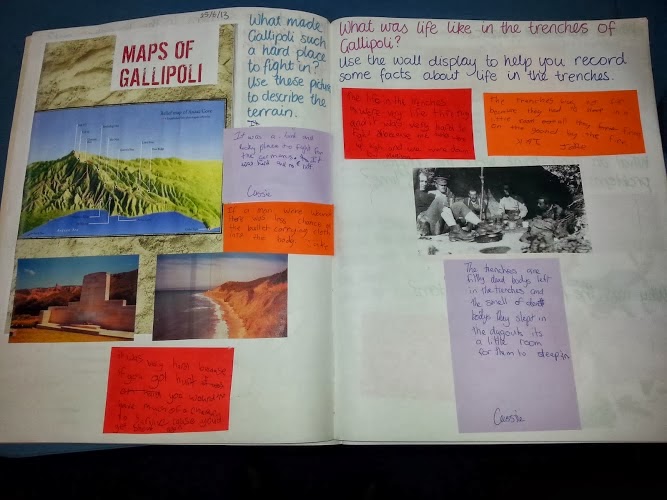


We then looked at other aspects that made Gallipoli challenging to the soldiers, such as the landscape, dead bodies that couldn't be removed, where they slept, flies, lice, fleas, weather.....  I used maps from other books, such as Gallipoli Reckless Valour by Nicolas Brasch, and photos from my own trip to Gallipoli for the Anzac Day commemoration in 2001.  I had set up the wall display (see below) to also help.  It had further photos from my trip to Gallipoli as well as pictures and text from selected books on trench life.
 
 
You can also see that my display also has references to the battlefields of France and Belguim.  I've also included a photo of my great grandfather who fought at Passchendaele and statistics from World War 1 which I felt were relevant.
 
Then it was time for a bit of a recap of what we knew before delving into the role of the donkeys at Gallipoli.
 
 
This next piece of text enabled us to consider some things that were explicitly said in the text and some things that we had to make educated assumptions about.  A good way of bringing those inferential skills into the lesson.
 
 
Some prediction skills came into this part of the text.  This is the good reason for photocopying the book.  You can control how far into the text the students get, to prevent them from wrecking all those wonderful skills like prediction and making hypotheses that you want to teach them.


On this page I was focusing on two main things:
  • using bullet points to list facts.
  • using inference to come to a conclusion about something that is not fully explained in the text.
The inference also meant they had to use what they had learnt from other sources such as photographs, videos we had watched, other text sources as well as this book.
 
 
Here I introduced the story of Simpson Kirkpatrick, from the book Gallipoli: Reckless Valour and we also had the poster on the wall display.  The students went away and found out some additional information at Simpson and created their own fact file about this legendary person from Gallipoli.
 
 
On this page there was a fair bit of inference in answering the questions and also using knowledge gleaned from other sources (other texts, videos, pictures).  The children are having to draw conclusions of their own, because this text is not explicitly telling the reader why these things are happening.
 
 
Finally the book has a factual bio about Richard Henderson to tell us what happened to him after Gallipoli.  I also told the group about who the author was, what he also did apart from writing this book.  I asked them to write questions for Glyn Harper.
 
I wanted to email the questions to Glyn, but we just ran out of time due to interruptions.  Another group I was working with did send him questions in relation to the Stuff article about the rations, and he was able to help us out with some answers.  It is really valuable for the students to be able to communicate with the authors.
 
We also verbally went back to our initial hypotheses about the book and discussed how accurate or different they were from the book now we had read it.
 
This was a great book to read with an able group of readers.  I would have preferred we hadn't had so many interruptions so we got through the book quicker, but we did take the opportunity to bring in other sources to give context to the time and place and events that we were reading about and this enhanced the learning for the students.

Friday, 28 March 2014

The Classroom Environment - what makes a class attractive?

After school today I thought I'd take a quick look at my blogs.  First though I took a glance through my blog roll and a post by Bruce Hammond caught my eye: New School Year - what has been achieved?  So I had a bit of a read. 
 
Bruce apparently had visited some schools towards the end of Week 6 and he said he was somewhat disappointed at the classroom displays.  This is what he said he had wanted to see:
 
I would've liked to have seen:

Evidence of a simple environmental study - based on students’ questions, valuing their ‘prior ideas’ including some observational drawings, language work and creative art. To ensure quality teachers need to teach simple presentation techniques/’scaffolds’.

I would've liked to have seen the above work well displayed with appropriate captions.

I would've also liked to have seen some focused personal writing about something the students’’ had experienced during their holidays. I would have liked to have seen these displayed well along with portraits or drawing featuring some aspect of the experience. To ensure students achieve best results teachers need to teach their students some simple presentation skills.
 
At the bottom of his post, Bruce had some practical links to unit ideas, lesson plans, ideas for the classroom environment and wall displays.
 
So it got me thinking, would Bruce be impressed with my classroom? 
 
Granted, I've made a big effort to have my class looking great by the end of Week 7 for three reasons:
  • I want the children to know that their work and learning is valued.
  • I want the parents to know their children are learning and to celebrate it.
  • We had the school centenary last weekend and I wanted to impress all the visitors (I got great responses from past pupils, teachers and families - one lady was even taking photos of the children's work around the room!).
So here are some photos from around my room.  I kind of walked around in a clockwise direction from my desk (but avoided photographing that bombsite!).
 
Firstly, this is the display of the first unit we did this year.  It's average by my standards.  The Vocab Expander was a language activity for some of the more able in my class.  The flags were from earlier in the term when we made up our own flag designs in response to John Key's initiation of the change the flag debate.  Below those are some pictures from a social studies resource about the Treaty.  And the projects to the right are two of four research projects by four students.


We have been doing geometry shapes and objects for maths.  The children used these shapes to help them describe the attributes of each shape.  They had to include how many sides and corners the shape had, and if the sides were straight, curved or continuous.  Each group had three students (one had four), and as a group they recorded the attributes, which is what those little cards dangling from each shape are.  Of course, despite having the correct spelling for most words needed on the board, some of the spelling is rather creative.


And here are more of the flags hanging on the wire across the back of the room.


Bruce wanted to see writing about the children's holidays.  Well here it is!!  No pictures sorry Bruce!!  And I must confess that I typed up 13/16 stories.  But the kids did get to choose the fonts, colours and borders.  It was purely a time thing.


Brendon McCullum made history with his 302 runs, and it was a great opportunity to write stories about it from Brendon's point of view.  The language that some of the children used to describe how Brendon may have felt inside of himself was great.  You may also notice that one story in the picture above and in the pictures below are actually photos.  One student has Downs Syndrome, so we used pictures from his family holiday, or photos of him playing cricket or things he likes doing or creating the same kind of picture so he has a 'story' too.


These are some of my resources for Te Reo Maori that I have made myself over the years.


During the summer holidays I saw this awesome photo on a Facebook feed I follow and I pinned it in
Pinterest as I thought it would be a great first week art activity.  I love it.  Just something simple, yet effective.

I wanted to reinforce the idea that we are all different and it's ok not to be the same.  This activity was also very good for including my special needs student and for the new Year 4s who need to learn about presentation.


I love calendars because of the amazing photography.  We were given a box of calendars on the Waikato that were from 2012 last year.  So I gave each child a calendar and asked them to choose the picture that spoke to them.  I really pushed using adjectives and similes (because it's the "done thing" to do now - and I didn't know what they were until I'd been teaching a few years and my stories at school were good!).  Yeah, I confess that I typed 11/14 stories.... but the kids choose the colours, fonts and borders!!


From a poem we were reading we got on the simile bandwagon.  For a change I got the kids to write them out and we kept the 'design' simple - go over the writing in felt, colour in the background with jovis or coloured pencils.


Here are the Bio Poems that I blogged about the other week.  I'm still so in love with them!!  I think it is the contrast of the black and white photo and text against the coloured background.  This time the kids did the typing.  However, I confess I printed out the photos.  The rest is all kid labour.


These pictures were created by tracing around 2-D shapes and then colouring them in.  Then I got them to write about what shapes they used to make different aspects of the picture.  Not the most exciting writing, but I have some kids that still struggle to match the name of the shape with the shape - not good in a class ranging from Year 4-8.


Ok, here is the commercial stuff - maps and flags.  We refer to the maps a lot.  I want kids to know where places are in New Zealand and the rest of the world.  It was something my teacher was big on when I was a kid, and I'm still grateful for it now.  I also think that it is important that they can recognise flags of different countries.  A bit of 'useless' general knowledge never hurt anyone, but might save them some embarrassment (or even their lives) if/when they do an OE.


The Thinking Hats by DeBono.  I refer to these a lot with our critical thinking.  Also you can see some Te Reo Maori resources I purchased from a local group as their fundraiser a few years ago.  And yes, that is a whiteboard beside an ActivBoard.


The big flower, bees and poppies were actually made last year, but I love them, so they are staying until a replacement display is made.  Yep, there is the commercialised literacy stuff on the walls for the children to refer to.  And that is my flag I bought to take to All Black games on my OE - I like to have it displayed as a reminder that my forebears fought under that flag for New Zealand.


And this is the next step on our geometry journey.  After demonstrating and teaching each child how to draw 3-D objects as you can see from photos of the kids books above of their efforts (love doing this on the ActivBoard), we then moved on to creating them with straws (below).  The next step will be to make the objects from nets.  They will be displayed from coat hangers hanging on more wire and will also have cards with the attributes of each object described.


So that is a trip around my classroom at the end of Week 8.  I hope you enjoyed it.  Maybe there is something you can take away from it.  And if you have any tips, they will be gratefully received.